

Evaluate Infralign
Sample audit
One unedited audit report from a real Azure estate.
The audit produces one Azure FinOps report from your connected cost and resource metadata. What arrives is a prioritised decision document, and every finding in it has been through a person first.
Click any image to enlarge. The live demo runs on this same NovaPulse estate, so you can click through the dashboards and reports instead of reading screenshots of them. It is read-only and connects to no Azure tenant.
What the report opens with
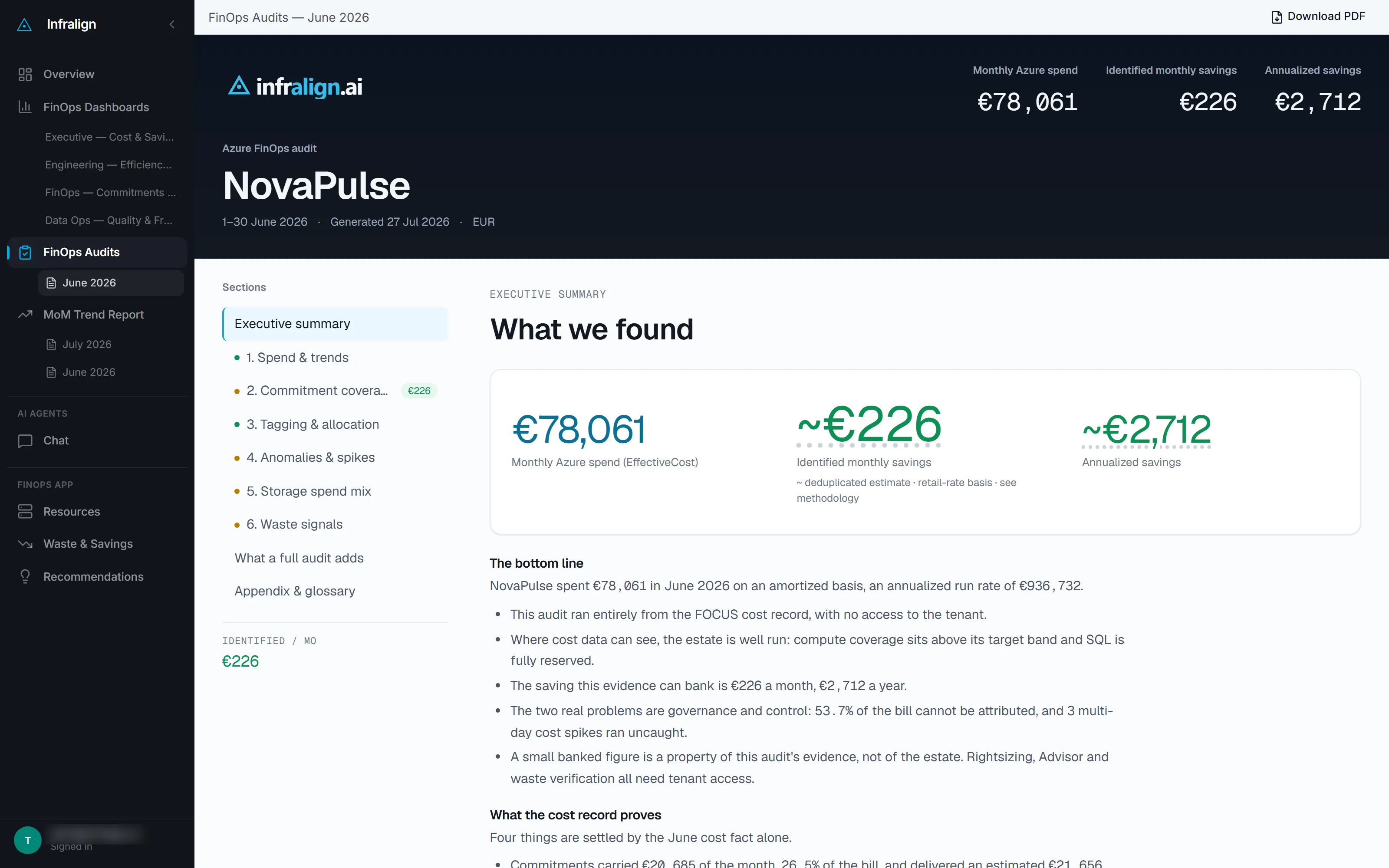
Section titled “What the report opens with”The first screen is the executive summary: the month’s spend and what the evidence can bank.
What each finding contains
Section titled “What each finding contains”Six fields, the same on every finding. Reading your audit report explains each one and shows how to prioritise across them.
| Field | What it carries |
|---|---|
| € impact | The estimated monthly saving in euros, from your billing data and Azure pricing. A modelled figure is labelled indicative until a change can be measured. |
| Evidence | Billing period, resource identifiers, the utilisation or configuration signal (for example 30-day p95 CPU or idle-day count), and source freshness. Advisor is named as an input, not as a verified answer. |
| Owner | The team or person best placed to approve the change, confirmed in the working session where tagging is thin. |
| Effort | What implementing the change involves, including any application-code changes. |
| Risk | The blast radius if the change misbehaves, stated plainly, with residual risk named. |
| Next action | Approve it, gather one missing piece of evidence, or park it with a review date. |
What a finding looks like
Section titled “What a finding looks like”The card below is a real commitment-coverage finding from NovaPulse, worth about €226 a month. Read it for the format: the chips carry severity, confidence, effort and basis, and the number underneath is the estimated monthly saving.
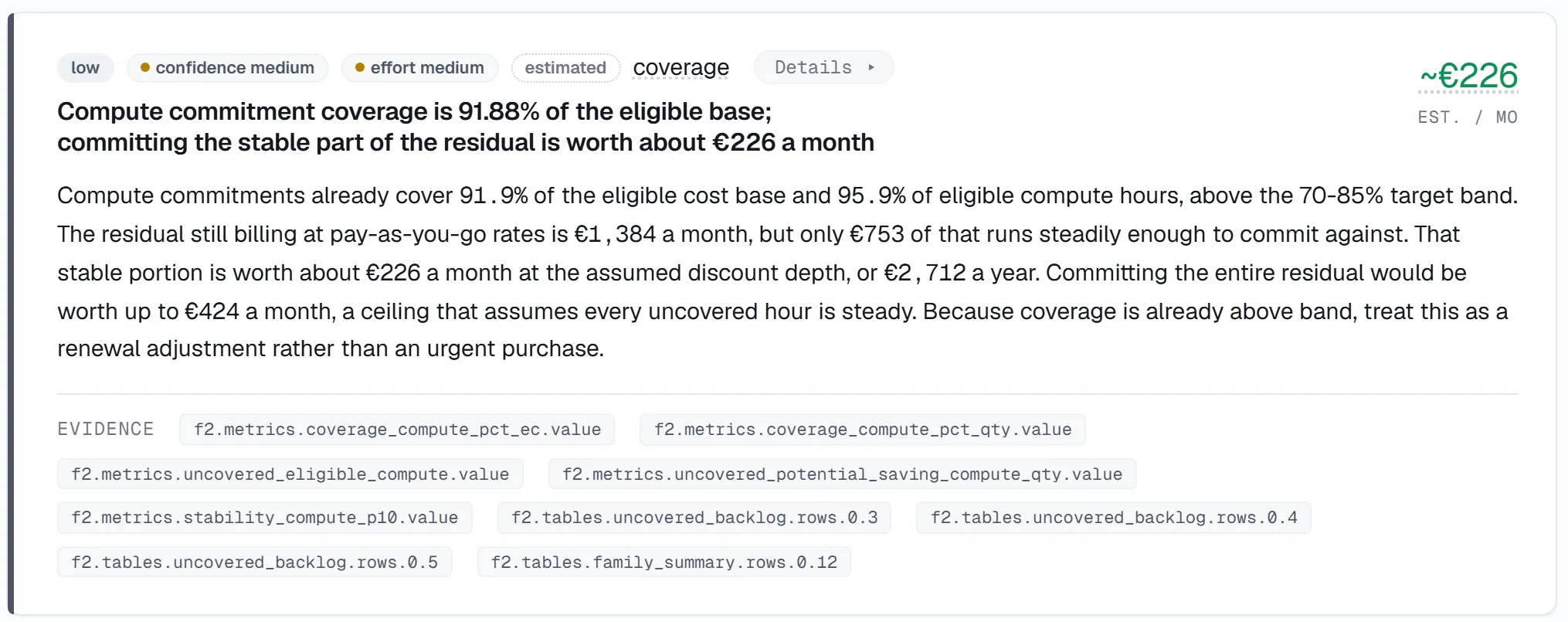
The evidence chips reference the exact warehouse fields behind the number; the readable evidence sits behind Details in the app.
A worked example
Section titled “A worked example”The case below is a different finding type, and a larger one. Every figure in it is indicative, not measured.
Opportunity: reduce the operating schedule of a non-production compute group.
| Field | Value |
|---|---|
| Indicative annual opportunity | €18,000–€22,000 |
| Evidence | 42 of the last 45 days show low utilisation outside agreed working hours; the estimate uses NovaPulse’s billed compute rate and the proposed schedule. |
| Confidence | Medium, pending dependency confirmation. |
| Effort | 1–2 engineering days. |
| Risk | Medium. Test and release windows must be confirmed. |
| Owner | Platform engineering. |
| Next action | Validate dependencies, approve a two-week controlled schedule trial. |
| Measurement | Compare like-for-like operating hours and billed cost after the observation period. |
A real finding is quantified only from your connected estate and your reviewed context. No saving is reported as verified until the agreed observation window closes. See savings measurement methodology.
Review sequence
Section titled “Review sequence”- An Infralign practitioner checks source coverage and reconciles the cost baseline.
- The practitioner reviews candidate findings for duplicates, weak evidence, and operational constraints.
- Your technical owner adds architecture and business context that read-only data cannot provide.
- The report is finalised with accepted, rejected, or investigation-needed decisions.
- In an engagement, selected findings move into human-led validated fixes.
What this report is not
Section titled “What this report is not”Nothing in it instructs you to buy a reservation, and nothing in it changes an Azure resource. The scope boundary around the audit is set out in what the audit covers.